Builder Tips
6 Years of Legal Exposure After Handover. Is Your Business Protected?
You built them a great home. The keys are handed over, the final payment is in, and you are on to the next job.Then the calls start.The dishwasher is making a noise. They cannot find the plumber’s
By Venki Arunachalam · 16 March 2026 · 5 min read

You built them a great home. The keys are handed over, the final payment is in, and you are on to the next job.
Then the calls start.
The dishwasher is making a noise. They cannot find the plumber’s number. Something on the roof looks wrong and they want you to take a look. Each call is 20 minutes you are not on site. Each call is a reminder that your last job never really ended.
Most builders accept this as part of the deal. It is not.
What the law actually says
Every residential builder in Australia operates under statutory warranties that cannot be written out of a contract, removed by mutual agreement, or simply ignored. They exist whether you know about them or not.
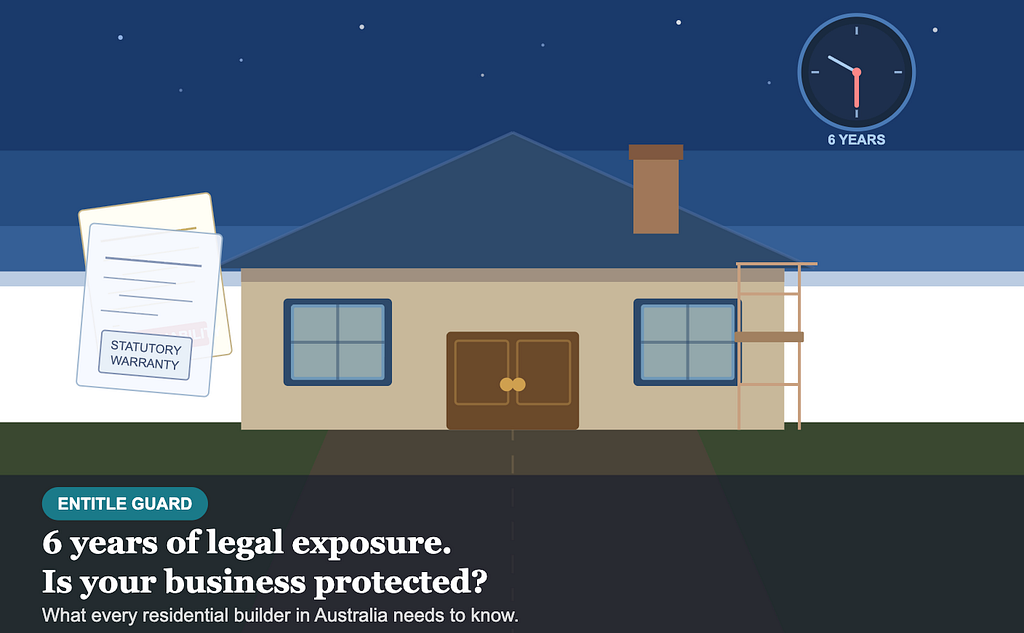
Australian law mandates that builders cover major structural defects for six years and non-structural issues for two years from the date of completion. Jonathan Homes These periods are set by state legislation and they apply regardless of anything written in your building contract.
The six year window covers the serious stuff. Foundations. Load-bearing walls. Roofing structure. Waterproofing. The kinds of defects that may not become visible for months or years after handover. A subsequent owner of the property, not just the person you built for, may make a claim that you are in breach of one or more of these warranties within six years for major defects. Housing Industry Association That means if the original owner sells the home in year two, the new owner can still come after you in year five.
There is more. If a breach of warranty only becomes apparent within the last six months of the warranty period, a further six months applies after the end of that period to commence proceedings. Bartier The clock does not simply stop.
The problem is not your workmanship
Here is the part that most builders find genuinely frustrating. The majority of post-handover disputes are not about structural defects at all.
They are about a homeowner who cannot find who installed the air conditioning unit. A warranty card that went missing in the move. A subcontractor’s number that nobody thought to save. A manufacturer’s fault that somehow becomes your problem because you are the only person the homeowner can reach.
NSW Fair Trading building inspectors assist in approximately 2,500 disputes each year, and over 80 per cent of these are resolved without enforcement action NSW Fair Trading — which sounds reassuring until you consider that even a resolved dispute costs you time, paperwork, and the kind of stress that bleeds into your next build.
The homeowner who cannot figure out who to contact will always call the builder first. And if the builder does not respond promptly, they escalate. A formal complaint to Fair Trading takes weeks to resolve. An NCAT tribunal application can run for months and cost thousands before anyone has even decided whose fault it was.
None of this needs to happen.
Documentation is the only thing standing between you and liability
When a defect claim arrives, your defence rests on one thing: a clear, documented trail showing who supplied what, when, under what warranty, and with what coverage.
Without that, you are arguing your case from memory against someone who has nothing to lose. With it, a claim that should have gone to a subcontractor or manufacturer goes exactly there, without touching you at all.
The builders who lose disputes are rarely the ones who did bad work. They are the ones who cannot prove what happened, who was responsible, and what the homeowner was told at handover.
The good news is that building this trail takes almost no extra effort if you do it at the right moment. The worst possible time to start collecting subcontractor details and warranty documentation is after something has gone wrong. The best time is during the build, when everything is at your fingertips.
One SMS changes the whole equation
Entitle Guard was built for this exact problem. Before handover, you load the property into the platform: every appliance, every subcontractor, every warranty and contact detail. At key handover, you send the homeowner one SMS. They tap it, and everything is waiting for them — searchable, organised, on their phone.
When something breaks, they open the app. The app tells them whether it is a manufacturer warranty, a trade issue, or something that falls under your statutory obligations. If it is genuinely your problem, it comes through to you properly documented. If it is not, it routes to the right person without you being involved at all.
You stop being the catch-all. Your documentation is in place from day one. And the homeowner experience is clean, professional, and far less likely to generate a complaint.
Setup takes about 30 minutes per property. The calls after handover drop. The paper trail that protects you exists before anything goes wrong.
Six years is a long time to be exposed. It is a very short time to set things up properly.
Check our brochure at https://brochure.entitleguard.com
or
Book a demo at https://entitleguard.com

Venki Arunachalam
Venki is the founder and CEO of Entitle Guard. He has built and led product teams across the globe for two decades, with a focus on AI and large scale platforms. He started Entitle Guard after one too many lost warranties at home.



The Entitle Guard app
Take Entitle Guard™ with you. Free on App Store and Google Play.